Industrial Power Distribution: Design, Safety & Efficiency | Abdullah International
Industrial Power
Industrial Power Distribution: Design, Safety & Efficiency
By Muhammad Adnan Chattha··
A technical engineering guide to industrial power distribution in Pakistan, covering substation sizing, safety compliance, and power factor correction.
Manufacturing facilities across Pakistan, from the textile clusters of Faisalabad to the heavy industrial zones of Port Qasim and Sundar, operate under severe energy constraints. With industrial electricity tariffs exceeding PKR 40 to PKR 55 per kilowatt-hour (kWh) and unpredictable grid voltage swings, a poorly designed electrical distribution system directly erodes profit margins. In-plant electrical distribution is not merely a collection of cables and breakers; it is an integrated engineering ecosystem that dictates operational uptime, equipment lifespan, and workforce safety.
Engineering an industrial network requires a systematic approach that balances initial capital expenditure against long-term maintenance costs and line losses. Whether setting up a greenfield plant or revamping a legacy textile or chemical facility, understanding the flow of power from the utility interconnection point down to the motor control centers is essential for dependable operation.
Load Profiling and In-Plant Substation Engineering
The design of an industrial electrical system begins at the point of common coupling (PCC) with the distribution company (such as FESCO, LESCO, or K-Electric). Industrial facilities typically receive power at medium voltage (11 kV or 132 kV). Converting this supply into a usable low-voltage (415V three-phase / 240V single-phase) network requires precise transformer sizing based on real maximum demand rather than connected load.
Calculating the maximum demand demands strict evaluation of diversity factors and load factors. Oversizing a transformer incurs high upfront equipment costs, increased switchgear ratings, and continuous no-load core losses. Conversely, undersizing results in chronic overheating, premature insulation degradation, and nuisance tripping during peak production cycles. For a standard 1,000 kVA oil-immersed step-down transformer (costing roughly PKR 4.5 million to PKR 6.5 million depending on the copper index and tier-one manufacturing), standard loading should stay between 70% and 80% of rated capacity during regular shifts.
Transformer selection must also account for the operating environment. While oil-immersed units (ONAN) dominate outdoor yards across Punjab due to their high thermal capacity, cast resin dry-type transformers are mandatory for indoor installations, multi-story processing units, or high-fire-risk chemical plants. Dry-type units eliminate fire hazards and dielectric fluid leakage, though they cost approximately 30% to 50% more than oil-filled equivalents.
Switchgear Selection and Protection Coordination
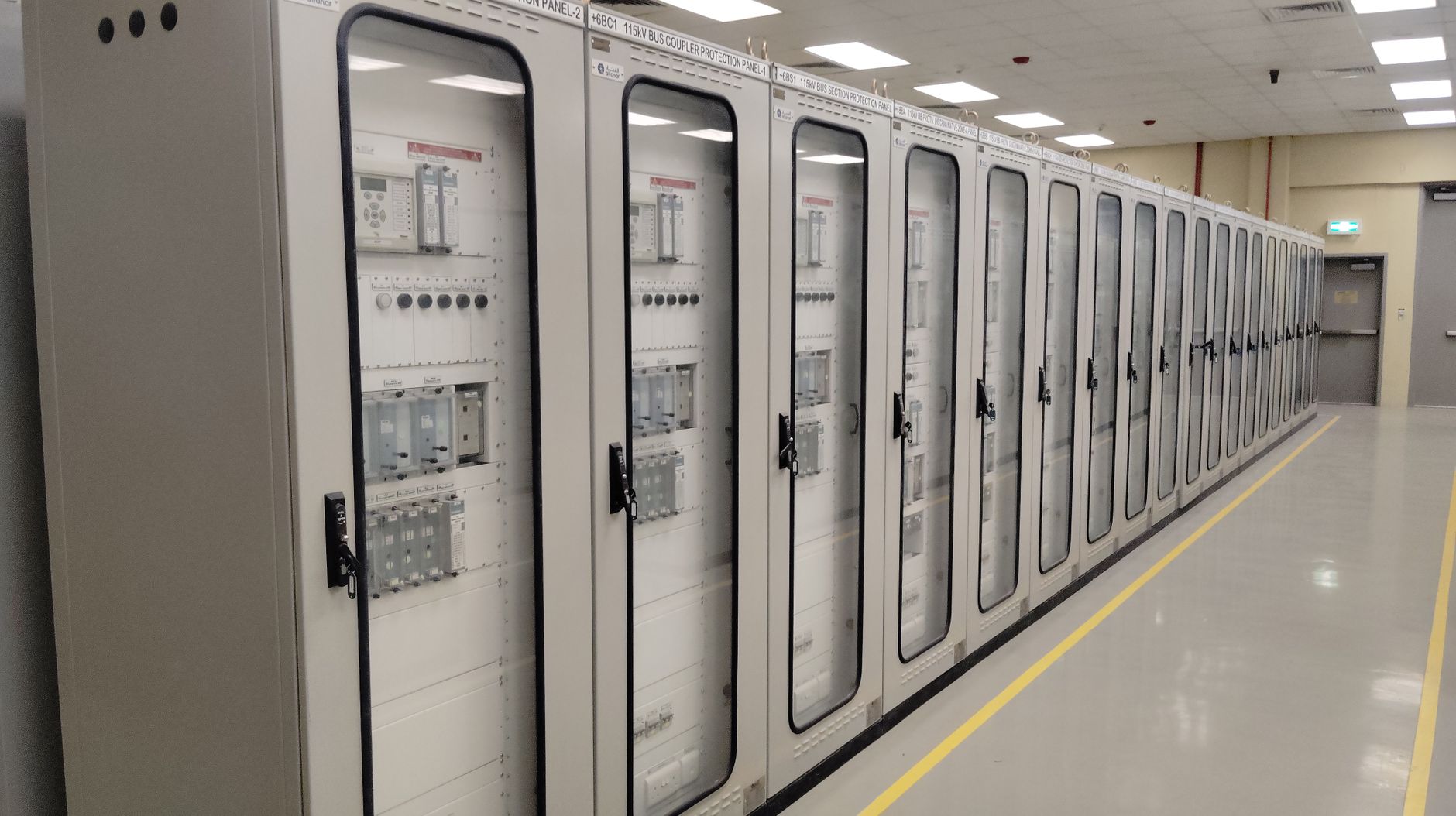
The medium-voltage (MV) and low-voltage (LV) switchgear act as the operational brain and protective shield of the facility. The medium-voltage incoming supply requires 11 kV Vacuum Circuit Breakers (VCBs) or SF6 gas-insulated units rated for fault-clearing capacities typically between 20 kA and 25 kA. On the low-voltage side, the Main Low Tension (LT) panel incorporates Air Circuit Breakers (ACBs) for high-amperage incomers (above 800A) and Molded Case Circuit Breakers (MCCBs) for downstream distribution feeders.
Ready to Discuss Your Project?
Contact Abdullah International today for a professional consultation and quotation. Our team is ready to deliver reliable electrical infrastructure solutions for your project.
A primary failure in local industrial design is poor protection coordination (discrimination). In an uncoordinated network, a minor short circuit on a small sewing floor or packaging machine can trigger the upstream main incoming breaker, shutting down the entire manufacturing facility. Proper time-current grading ensures that the protective device closest to the fault trips first, isolating the problem branch within milliseconds while keeping the rest of the facility energized.
Busbar design within the main switchboard demands equal scrutiny. Main busbars must be manufactured from high-conductivity electrolytic copper (99.9% purity) and sized to keep operating temperatures below 85°C at full load. In industrial cities where summer ambient temperatures hit 48°C, unverified busbar sizing leads to catastrophic switchgear fires. Abdullah International emphasizes verified type-tested switchgear assemblies built to IEC 61439 standards to avoid premature busbar oxidation and phase-to-phase flashovers.
Power Factor Correction and Harmonic Mitigation
Power factor management directly impacts utility bills in Pakistan. National Electric Power Regulatory Authority (NEPRA) regulations enforce strict penalties on industrial consumers whose average monthly power factor drops below 0.90 lagging. In contrast, keeping the power factor between 0.95 and 0.98 lowers total current draw, minimizes internal $I^2R$ heat losses in feeder cables, and recovers significant capital through utility billing credits.
Achieving this requires a centralized Automatic Power Factor Improvement (PFI) plant installed directly at the main LT distribution board. A standard PFI setup uses microprocessor-based controllers that stage metallized polypropylene film capacitors in steps (typically 25 kVAR, 50 kVAR, or 100 kVAR). A 500 kVAR PFI bank represents an investment of approximately PKR 1.8 million to PKR 2.8 million, but the elimination of DISCO low-power-factor penalties usually yields a complete payback within six to nine months.
However, standard capacitors cannot be deployed blindly in modern plants equipped with variable frequency drives (VFDs), computerized knitting machines, CNC routers, or induction furnaces. These non-linear loads inject high-order harmonic currents (mainly 5th, 7th, and 11th orders) into the electrical network. When harmonics align with the natural frequency of standard capacitor banks, electrical resonance occurs, causing bulging capacitors, blown fuses, and catastrophic transformer overheating. Engineers must install 7% or 14% detuned harmonic filter reactors in series with capacitors to suppress resonance and protect equipment.
Cable Sizing, Busway Trunking, and Thermal Derating
Cable selection determines the distribution network's efficiency and voltage stability. Designers must avoid relying solely on basic cable-carrying capacity tables. In Pakistan's climatic conditions, cables must be derated for ambient temperature, grouping, burial depth, and continuous operating cycles.
A copper XLPE cable that carries 300A in a 30°C open-air laboratory environment may safely carry only 210A to 230A when laid in an unventilated cable trench alongside four other live cables under a 45°C ambient summer environment in Punjab or Sindh. Undersized cables cause significant voltage drops. If the terminal voltage at an induction motor drops by more than 5% below its 400V rating, the motor draws excess current to produce its rated torque, overheating the windings and cutting the motor's operational life in half.
``
Voltage Drop Calculation Check:
VD = √3 × I × L × (R cos φ + X sin φ)
Where:
- I = Load current (Amperes)
- L = Route length (kilometers)
- R = Conductor resistance (Ω/km)
- X = Conductor reactance (Ω/km)
- cos φ = System power factor
``
For continuous production facilities requiring heavy lateral distribution, such as composite textile units or automotive assembly lines, conventional multi-core cable runs become bulky, difficult to modify, and thermally inefficient. Sandwich-type Busbar Trunking Systems (BBTS) offer a superior alternative. Although BBTS carries an initial cost premium of 20% to 30% over cable-tray installations, it saves floor footprint, cuts installation labor times by up to 60%, and features plug-in tap-off units that allow factory floor managers to relocate machinery without rewiring main switchboards.
Industrial Earthing and Life Safety Infrastructure
Earthing (grounding) in an industrial plant is fundamentally about two things: clearing fault currents rapidly to prevent fires, and eliminating touch potential to protect workers from lethal electric shocks. Industrial plants in Pakistan must comply with IEEE 80 and IEC 60364 grounding safety regulations.
An industrial facility requires a multi-point, low-impedance earthing grid. Grounding pits using high-purity copper-bonded steel rods (minimum 250-micron coating) combined with bentonite or chemical earthing compounds provide stable earth path resistance. The maximum allowable earth resistance for industrial main boards must not exceed 1.0 Ohm, while sensitive equipment such as programmable logic controllers (PLCs), instrumentation racks, and server rooms require clean, dedicated earthing below 0.5 Ohms.
Arc flash protection represents another critical safety frontier that is frequently overlooked. Switchgear operating at 415V with high upstream transformer capacities can release tremendous incident energy during a direct phase fault. Industrial setups must include:
* Proper ingress protection (minimum IP54 for dusty processing floors).
* Internal phase separation barriers (Form 3b or Form 4b construction).
* Integrated earth leakage relays (ELRs) coupled with current-operated residual circuit devices.
* Surge Protection Devices (SPDs, Type 1 and Type 2) at the main LT incoming bus to deflect high-voltage lightning surges and grid switching transients.
Integrating Captive Generation and Solar PV Arrays
Given current grid unreliability and high fossil fuel costs, very few Pakistani manufacturing setups rely exclusively on the utility grid. Most operate a hybrid setup consisting of the DISCO grid, diesel/gas generators, and rooftop photovoltaic (PV) solar arrays. Managing these sources demands sophisticated synchronization and automated distribution panels.
When integrating rooftop solar systems (often 500 kWp to 2 MWp on industrial sheds), reverse-power protection becomes mandatory. Gas or diesel generators can become unstable and suffer internal engine damage if solar generation suddenly exceeds plant consumption and feeds reverse power into the generator alternator. Distribution boards must incorporate motorized tie-breakers, zero-export controllers, and PLC-driven automatic transfer switches (ATS) capable of shedding non-critical loads within 5 to 10 seconds of a grid outage.
Execution experience is decisive here. As an engineering firm active in Pakistan's industrial heartland for over two decades, Abdullah International implements power automation systems that dynamically balance grid supply, solar output, and backup generators to minimize fuel consumption while preventing plant brownouts.
Conclusion
An efficient, safe, and dependable industrial power distribution network requires rigorous upfront engineering: accurate transformer sizing, calculated thermal derating of cables, detuned power factor correction, and strictly separated earthing grids. Cutting corners on switchgear ratings or cable cross-sections to minimize initial capital expenditure consistently leads to operational disruption, high energy losses, and severe safety hazards.
Actionable Takeaway: Commission a comprehensive single-line diagram (SLD) review and power quality audit of your existing distribution boards. Measure real harmonic distortion levels (THD-i and THD-v) under peak operating conditions, and verify that your switchgear earth resistance remains strictly below 1.0 Ohm before the onset of the peak summer production cycle.