Industrial Power Distribution Guide: Design & Safety in Pakistan | Abdullah International
Industrial Power
Industrial Power Distribution Guide: Design & Safety in Pakistan
By Muhammad Adnan Chattha··
Learn how to design safe, efficient industrial power distribution systems in Pakistan. Cut downtime, manage peak loads, and comply with NEPRA standards.
Industrial facilities across Pakistan operate in one of the most demanding power environments in South Asia. Facilities in industrial hubs like Faisalabad, Gujranwala, and Karachi face severe challenges, including unannounced grid shedding, wide voltage fluctuations between 360V and 440V, and escalating electricity tariffs exceeding PKR 45 per unit for peak industrial hours. In this environment, an unplanned power interruption can ruin entire production batches in textile spinning mills or damage induction furnaces in steel re-rolling plants. Proper industrial power distribution forms the technical backbone of your plant, bridging the gap between volatile utility supply lines, captive generators, and sensitive manufacturing machinery.
Grid Interconnection and Substation Design (11kV to 415V)
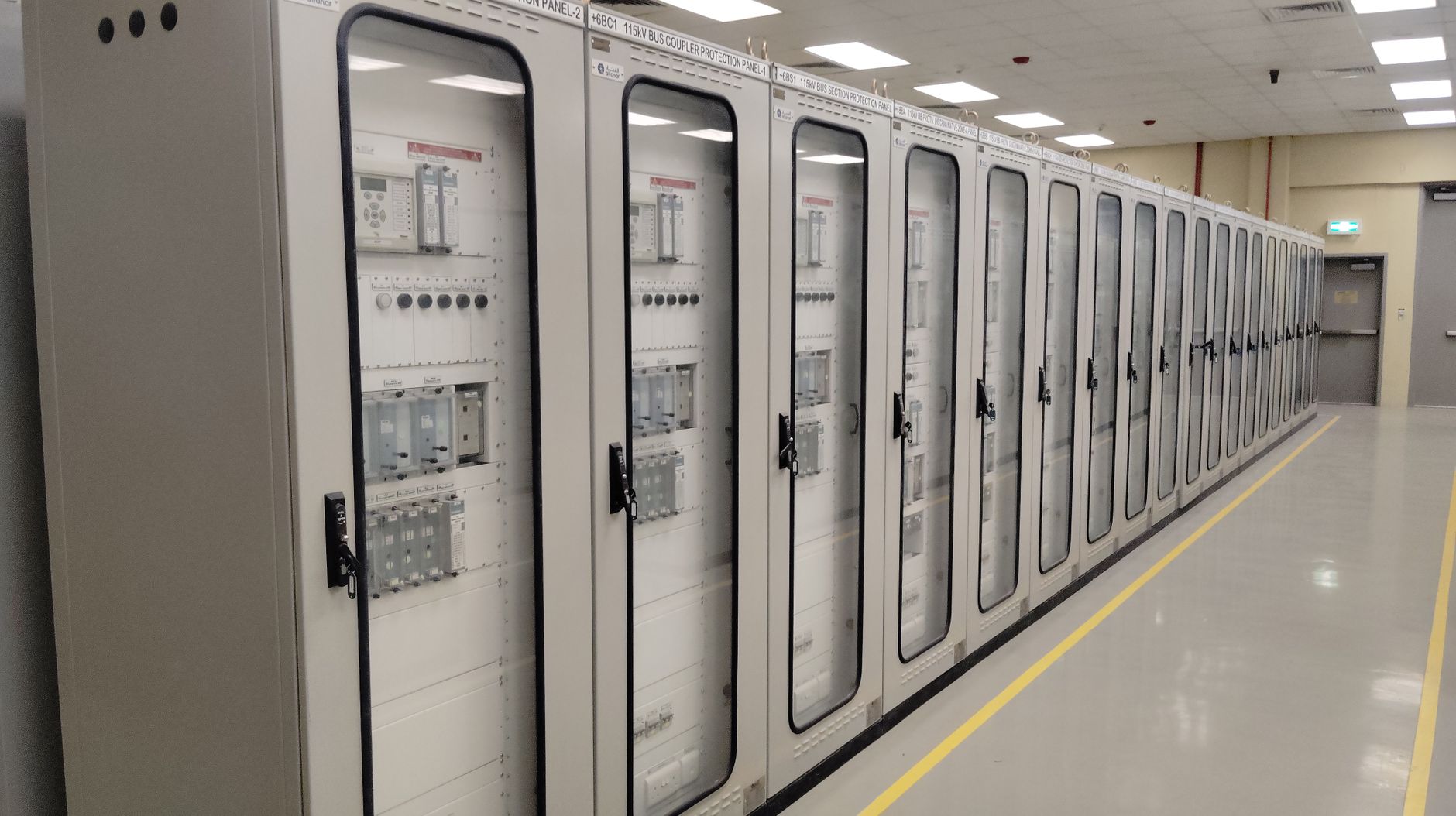
Most medium-to-large production units receive electric power from distribution companies (DISCOs) like FESCO, LESCO, or K-Electric at 11kV, while heavy manufacturing sites step down from 132kV. The incoming transmission connects directly to an on-site primary substation. High-tension (HT) switchgear must house vacuum circuit breakers (VCBs) or SF6 gas-insulated breakers equipped with microprocessor-based protection relays that detect overcurrent, earth faults, and under-voltage conditions within milliseconds. An HT panel setup typically costs between PKR 2,000,000 and PKR 4,500,000 depending on breaking capacity (typically 25kA or 31.5kA) and protection relay specifications.
The core of the substation is the step-down distribution transformer, which reduces 11kV utility voltage to a standard three-phase 415V line-to-line output (240V line-to-neutral). Industrial buyers must select between oil-immersed ONAN (Oil Natural Air Natural) transformers and dry-type cast resin units. While oil-immersed units are cost-effective for outdoor switchyards, cast resin transformers are mandatory for indoor installations near process floors due to zero fire risk. In Pakistan’s ambient summer temperatures—often reaching 48°C in Punjab and Sindh—transformer de-rating must be factored in during the initial engineering phase. Selecting high-grade electrolytic copper winding over aluminium reduces core losses and extends equipment service life well past 20 years.
Proper substation layout demands strict adherence to PEC (Pakistan Engineering Council) and NFPA regulations. Transformers require dedicated containment pits with crushed gravel to capture oil leaks, physical separation blast walls between parallel units, and clean ventilation paths. Poor substation ventilation causes ambient room temperatures to exceed 55°C, accelerating oil degradation, tripping thermal relays, and shortening the operational life of switchgear insulation.
Main Distribution Boards (MDB) and Busbar Trunking Systems
Ready to Discuss Your Project?
Contact Abdullah International today for a professional consultation and quotation. Our team is ready to deliver reliable electrical infrastructure solutions for your project.
The secondary side of the step-down transformer routes power into the Low Tension (LT) switchgear or Main Distribution Board (MDB). The LT switchgear controls plant-wide energy allocation using high-capacity Air Circuit Breakers (ACBs) rated from 1,600A up to 6,300A with electronic trip units. These boards separate power feeds into distinct production sections, utility networks (such as chillers, air compressors, and effluent treatment plants), and administrative loads. Enclosures should feature Form 4b internal segregation to ensure maintenance work on one outgoing circuit does not expose technicians to live adjacent busbars.
Engineers must choose between conventional multiconductor cable arrays and modern Busbar Trunking (BBT) systems. In a standard textile weaving facility, running twelve 500 mm² single-core copper cables per phase across 150 meters creates significant structural load, voltage drop, and termination clutter. Sandwich-type aluminium or copper BBT runs offer a compact alternative, reducing line reactance and lowering voltage drop along high-current paths. While copper busbar trunking carries an initial cost premium of 30% to 40% over cable trays, BBT systems allow engineers to add or relocate tap-off units without shutting down the entire line.
Busbar design inside the MDB demands strict engineering analysis. Busbars must be sized according to short-circuit withstand ratings—often calculated at 50kA or 65kA for one second—to prevent physical deformation during fault events. Abdullah International designs custom LT switchboards using 99.9% pure ETP (Electrolytic Tough Pitch) grade copper with tin plating, calculating surface area dimensions to maintain temperature rises within IEC 61439 safety limits.
Power Factor Correction and Utility Penalty Avoidance
NEPRA regulations and local DISCO tariff structures impose direct financial penalties on industrial consumers whose average monthly power factor drops below 0.90 lagging. DISCOs bill a 2% surcharge on the overall monthly bill for every 1% drop below this threshold. For a processing mill running a 2.5 MW load with a monthly electricity bill of PKR 18,000,000, allowing the power factor to slip to 0.85 can yield an avoidable penalty of over PKR 1,800,000 per month. Operating at or near 0.98 lagging keeps power bills lean and frees up internal distribution capacity.
Correcting the power factor requires automatic power factor correction (APFC) capacitor banks linked to the primary distribution bus. An intelligent APFC controller senses phase angle displacement via current transformers (CTs) and steps microfarad capacitor stages in and out through heavy-duty contactors or thyristor switches. A well-engineered APFC panel for an 800 kVA load costs approximately PKR 1,200,000 to PKR 2,000,000. In most operational settings, this investment pays for itself within three to five months purely through penalty savings and reduced reactive power demand.
Designers must protect capacitor banks from harmonic resonance. Capacitors have low impedance at high frequencies, which attracts harmonic currents generated by plant non-linear loads. Without series detuning reactors (typically 7% or 14% reactance), standard metalized polypropylene capacitors overheat, bulge, and rupture. Installing detuned APFC panels prevents resonance, lowers system stress, and preserves the lifespan of utility billing meters.
Harmonic Mitigation and Industrial Power Quality
Non-linear industrial loads have expanded rapidly across Pakistani industries. Variable Frequency Drives (VFDs) running loom motors, DC drives on extruders, unshielded server racks, and induction heating equipment all distort linear sine waves. This non-linear operation generates high total harmonic distortion (THD). Elevated THD produces excessive eddy current losses inside distribution transformers, nuisance tripping of main breakers, premature bearing wear in induction motors, and neutral wire overheating.
Field measurements across manufacturing corridors frequently reveal current THD figures exceeding 28%, far above the 5% limit established by IEEE 519 standards. Passive tuned LC filters can smooth harmonics for fixed-speed loads, but dynamic industrial environments require Active Harmonic Filters (AHF). AHFs monitor load currents in real time and inject counter-phase harmonic compensation up to the 50th order, suppressing current THD down to less than 3% at the common coupling point.
Deploying proper filtering saves real money by preventing unmetered internal system losses. When harmonic currents circulate through factory cables, resistance creates heat (I²R losses) that does no mechanical work but still registers on the utility meter. Maintaining a clean sinusoidal waveform lowers electrical equipment running temperatures by 8°C to 12°C, reducing cooling demands in production areas and protecting sensitive automation controllers from memory faults.
Grounding, Earthing, and Lightning Protection
Earthing provides the critical safety baseline for all downstream electrical networks. Pakistani plants must deploy segregated earthing systems: protective equipment earthing, neutral earthing for transformers and generators, and clean instrument earthing for DCS/SCADA automation networks. Interconnecting control instrumentation directly to raw machinery ground creates ground loops that introduce electrical noise into 4-20mA sensor loops, corrupting automated production data.
Soil resistivity across Pakistan varies widely, from low-resistance silt near the Indus basin (15–30 ohm-meters) to high-resistance rocky ground in the Potohar plateau and Balochistan (exceeding 300 ohm-meters). Substation earth pits must achieve an earth resistance value below 1.0 ohm, while precision data systems require less than 0.5 ohm. Contractors achieve these parameters using chemical earthing pits filled with high-conductivity bentonite or carbon-based backfill compounds around 3-meter copper-bonded steel rods, replacing traditional salt-and-charcoal pits that corrode copper plates and dry out during the summer.
Lightning protection requires equal engineering attention, particularly for facilities operating in northern Punjab and Khyber Pakhtunkhwa. Air terminal rods, down-conductors, and Type 1 and Type 2 Surge Protective Devices (SPDs) installed on incoming switchgear panels protect microprocessors from lightning-induced voltage spikes. Equipotential bonding bars must link all metal structural elements, pipes, and electrical enclosures to eliminate dangerous potential differences during transient fault events.
Cable Sizing, Voltage Drop, and Safety Standards
Undersized electrical cables represent a common shortcut in local construction, leading to fire risks and chronic efficiency losses. Plant cable schedules must be calculated based on continuous current ratings, ambient derating factors, grouping factors within cable trays, and prospective fault current withstand durations. Leading local manufacturers like Pakistan Cables, Fast Cables, and Newage Cables produce certified XLPE and PVC insulated options that comply with international standards. XLPE-insulated cables are preferred for power runs because they tolerate continuous conductor temperatures of 90°C compared to 70°C for PVC, allowing higher current carrying capacities per square millimeter.
Voltage drop calculations should be kept within 2.5% for lighting systems and 4% for dynamic motor feeds. In sprawling textile processing or packaging plants where distribution runs exceed 200 meters, choosing a cable based solely on continuous load current leads to unacceptable voltage sag at the motor terminals. When line voltage falls below 380V under full load, induction motors pull extra current to maintain torque, driving internal motor windings past safe operational temperatures:
$$V_{drop} = \sqrt{3} \times I \times L \times (R \cos\phi + X \sin\phi)$$
This mathematical check confirms whether the selected conductor cross-section maintains terminal voltage under transient motor starting spikes.
Cable routing layout requires physical separation between high-voltage power cables, low-voltage control lines, and sensor communications. Heavy power conductors must be laid in perforated, hot-dip galvanized cable trays with ladder runs for vertical risers. Stacking unsorted power cables directly on unventilated floor trenches produces severe thermal bundling, reducing rated ampacities by up to 40% and creating hidden ignition hazards behind main switchgear banks.
Integrating Captive Power and Generator Synchronization
Given persistent grid instability, Pakistani factories rely on hybrid generation networks incorporating captive diesel generators, natural gas gensets, and large-scale industrial rooftop solar arrays. Synchronizing these alternative generation sources with the utility feed demands sophisticated load management architecture. Auto Mains Failure (AMF) and Auto Transfer Switch (ATS) panels must be interlocked through mechanical and electrical contactors to block back-feeding into dead DISCO utility lines during power cuts, which could fatally injure grid line workers.
Modern facilities employ automated synchronization panels running controllers like Deep Sea Electronics (DSE) or Deif. These systems match voltage, frequency, and phase angles across multiple generators before closing parallel bus ties. Parallel multi-engine configurations run smaller 500 kVA or 1,000 kVA generators in sequence to match actual plant demand, avoiding wet-stacking and excessive fuel consumption caused by running a single 2,500 kVA diesel unit at 20% load capacity.
Integrating rooftop solar PV systems introduces real-time reverse power challenges. When factory machinery trips or shuts down on weekends, surplus solar generation can back-feed into captive diesel generators, which causes engine hunting and trips the reverse power relay. Industrial distribution systems require zero-export reverse power controllers to throttle solar inverter production when plant consumption falls below the minimum safe loading threshold of active diesel units. Abdullah International integrates automated power management systems that calculate real-time generator and solar output, protecting machinery and reducing fuel consumption across all shifts.
Conclusion
Industrial power distribution is not simply an assembly of transformers, breakers, and cables; it is a critical engineering system that directly dictates your plant's profitability, equipment reliability, and operational safety. In an industrial market where electricity prices continue to climb, a poorly designed power network drains operational budgets through reactive power penalties, harmonic losses, and unplanned assembly line shutdowns. Investing in precision switchgear, detuned APFC systems, certified cable routes, and balanced grounding preserves electrical assets and minimizes factory downtime. Conduct a comprehensive on-site power audit of your main distribution boards this month—measuring power factor, harmonic distortion, and thermal profiles under full manufacturing load—to identify vulnerabilities before they cause costly hardware failures.