
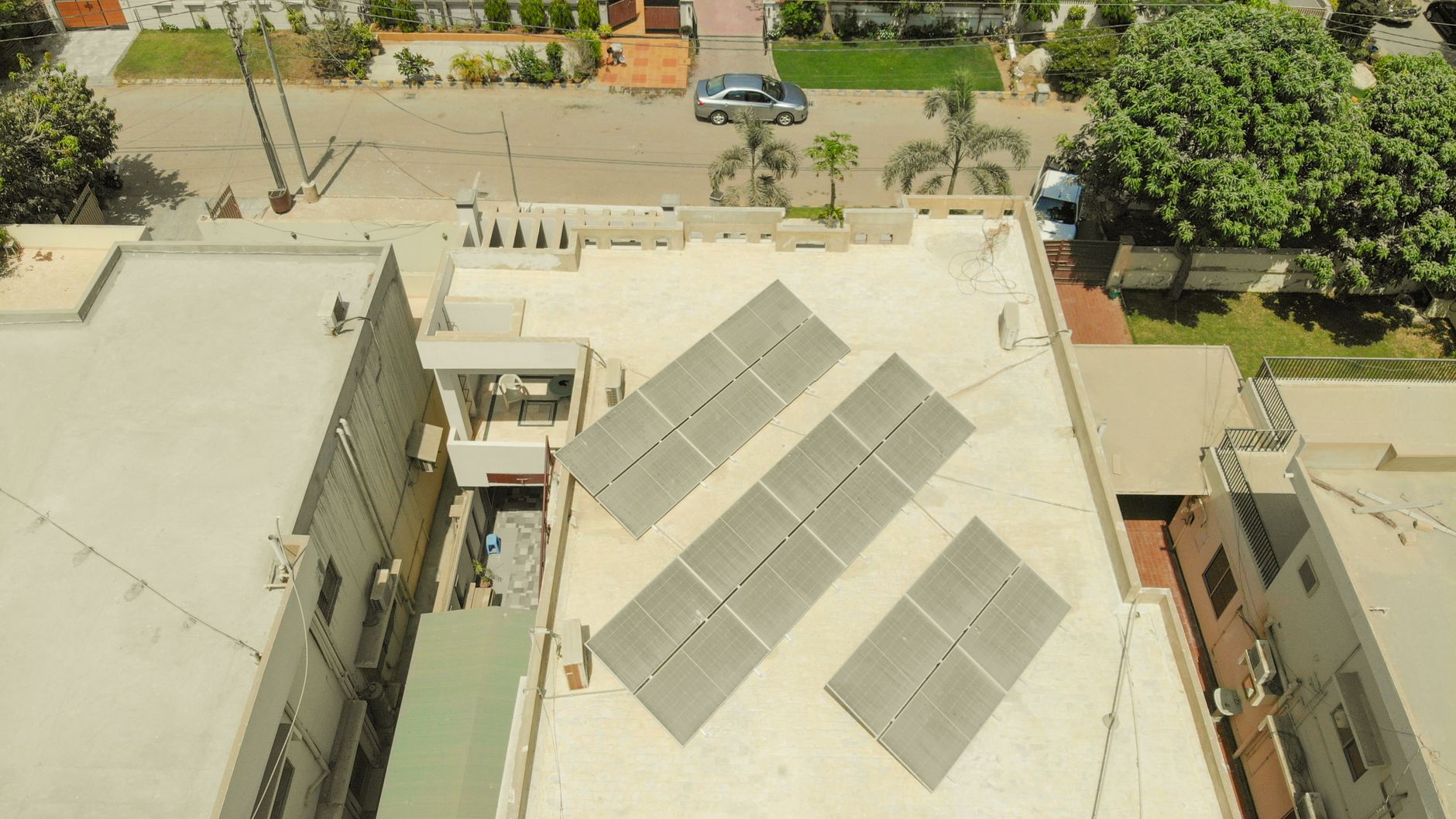
Pakistan possesses some of the highest solar irradiance levels in South Asia, averaging between 5.3 and 6.2 kWh/m² per day. From industrial rooftops in Faisalabad and Karachi to residential arrays across Lahore and Multan, solar adoption has surged in response to escalating grid tariffs from power distribution companies (DISCOs). However, many plant owners notice an unexpected drop in kilowatt-hour output between April and September. A system with a nameplate capacity of 100 kW often delivers significantly less peak power than expected during the sunniest months.
This gap between expected and actual yield is rarely caused by manufacturing defects. Instead, it stems from the mismatch between laboratory test standards and Pakistan's severe operating environment. Real-world solar efficiency depends directly on three physical factors: ambient temperature, airborne particulate matter, and regular maintenance. Understanding these variables allows plant owners and facility managers to design systems that maximize output under challenging climatic conditions.
The Standard Test Condition Gap: Lab Ratings vs. Local Climate
Solar photovoltaic (PV) modules receive efficiency ratings based on Standard Test Conditions (STC). In laboratory testing, panels are exposed to an irradiance of 1,000 watts per square meter, an air mass of 1.5, and a constant cell temperature of 25°C. These conditions rarely exist simultaneously in Pakistan's plains.
While midday solar irradiance in Punjab and Sindh regularly exceeds 1,000 W/m², the cell temperature inside the panel almost never stays at 25°C during daylight hours. A dark solar panel absorbs solar radiation and heats up well past the ambient air temperature. On a 42°C summer afternoon in Faisalabad or Sahiwal, the actual operating temperature of a photovoltaic cell sits between 65°C and 75°C. Because photovoltaic conversion relies on semiconductor physics that degrade as heat rises, calculating field yields based solely on factory STC metrics guarantees inaccurate financial projections.
High Ambient Heat and the Temperature Coefficient Factor
Every solar module carries a technical specification known as the Temperature Coefficient of Pmax. This figure indicates the percentage of power output a panel loses for every single degree Celsius the cell temperature rises above 25°C. For standard monocrystalline PERC modules, this coefficient typically ranges from -0.34% to -0.38% per degree Celsius. Modern N-type TOPCon panels perform better, averaging around -0.30% per degree Celsius, while Heterojunction (HJT) panels sit near -0.26% per degree Celsius.
To understand the financial impact on a system, consider a standard 550W Mono PERC panel with a coefficient of -0.35%/°C operating on a typical June afternoon in central Punjab. If the ambient temperature is 44°C, the internal cell temperature easily reaches 68°C. This represents a 43°C increase above the 25°C baseline. Multiplying 43°C by 0.35% reveals an efficiency loss of 15.05%. The 550W panel instantaneously downrates to roughly 467W of peak output solely due to thermal stress.