
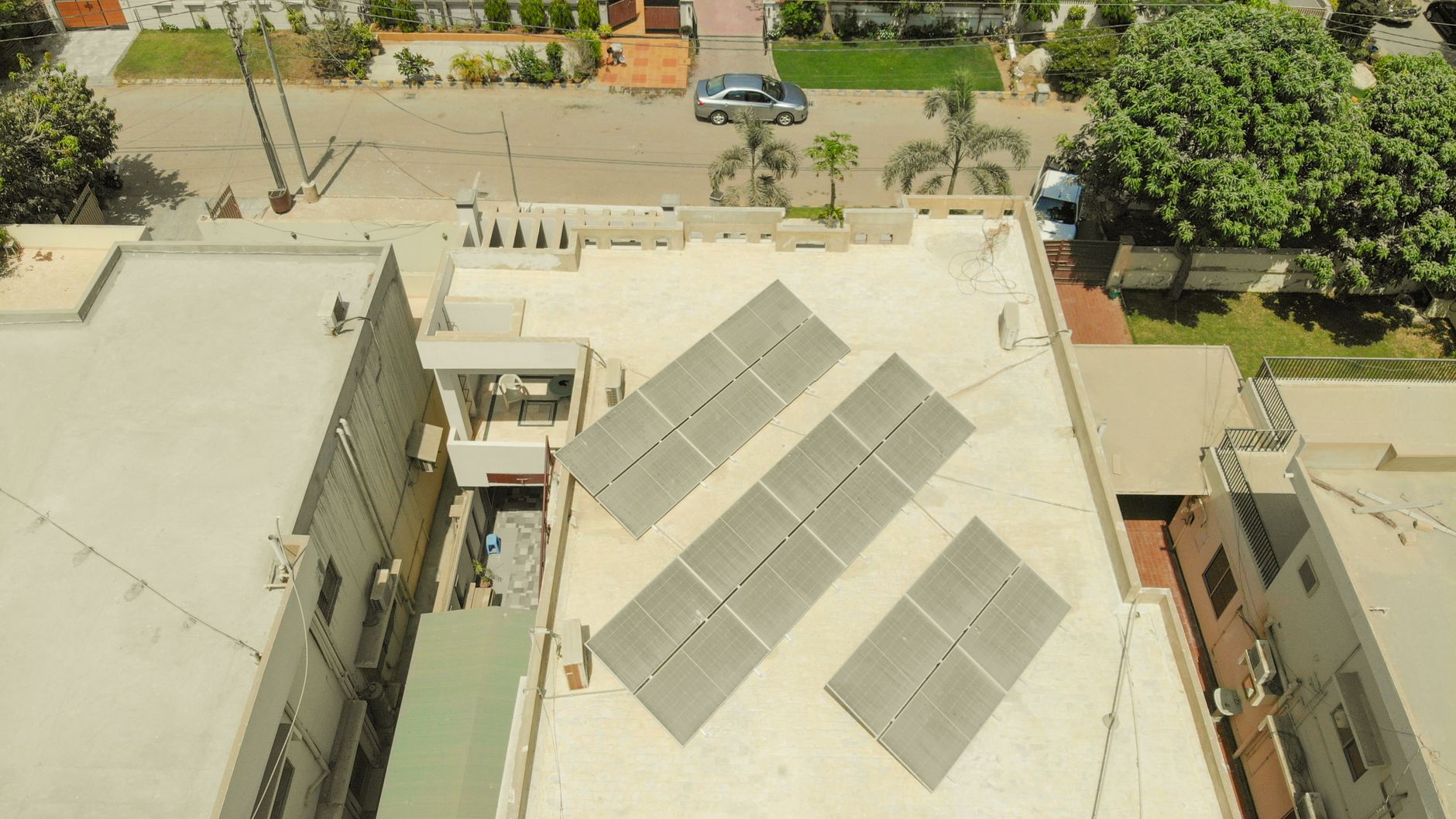
Pakistan has experienced a massive shift toward photovoltaic (PV) generation over the past five years. Driven by soaring grid tariffs—frequently exceeding PKR 60 to PKR 75 per kilowatt-hour (kWh) for peak industrial and residential users—rooftop and ground-mounted arrays have become essential power infrastructure. However, system owners often notice a troubling trend: panels rated at 550 watts or 650 watts rarely produce their nameplate output during the sunniest months of May, June, and July. The discrepancy between laboratory ratings and field yields comes down to the operating environment. Pakistan features some of the highest solar irradiance levels in South Asia, yet its extreme ambient temperatures, airborne dust, seasonal agricultural burning, and industrial smog combine to reduce solar efficiency well below factory expectations.
Standard Test Conditions vs. Pakistani Climatic Realities
Solar panels carry nameplate wattage ratings established under Standard Test Conditions (STC). In a factory lab, STC defines an irradiance of 1,000 watts per square meter, an air mass of 1.5 (AM1.5), and, crucially, a cell temperature of 25°C. These baseline figures allow manufacturers to establish a standardized benchmark, but they bear little resemblance to daily conditions across the plains of Punjab, the arid expanses of Sindh, or the deserts of Balochistan.
In cities like Faisalabad, Multan, Sukkur, and Sibbi, ambient summer temperatures routinely cross 44°C to 48°C. Because photovoltaic modules are dark, glass-faced units absorbing high amounts of infrared radiation, their actual internal cell temperature runs 20°C to 30°C hotter than the surrounding air. A system operating under a 42°C afternoon in southern Punjab frequently reaches an internal cell temperature of 68°C to 72°C. At this operating point, the fundamental physics of silicon semiconductors shifts, resulting in a measurable decline in operational voltage and an unavoidable drop in total system power output.
High Temperatures and the Temperature Coefficient
Every solar panel datasheet includes a parameter termed the "Temperature Coefficient of Pmax" (maximum power). This metric, expressed as a negative percentage per degree Celsius, indicates how much power the panel loses for every single degree the cell rises above the 25°C STC mark. Older polycrystalline panels carried coefficients as steep as -0.42%/°C. Modern P-type monocrystalline PERC panels generally operate around -0.35%/°C, while newer N-type TOPCon and Heterojunction (HJT) technologies have lowered this penalty to roughly -0.30%/°C and -0.26%/°C respectively.
To understand the real-world financial cost, consider a standard 100 kW industrial installation using Monocrystalline PERC modules with a -0.35%/°C coefficient. On a summer afternoon in Faisalabad with the ambient air at 45°C, the cell temperature inside the modules can easily climb to 70°C. That is an elevation of 45°C above the 25°C rating: