Why Your Breaker Keeps Tripping: Fault Finding and Fixes | Abdullah International
Maintenance
Why Your Breaker Keeps Tripping: Fault Finding and Fixes
By Muhammad Adnan Chattha··
Frequent breaker tripping disrupts operations and signals electrical hazards. Learn key causes, step-by-step fault finding, and practical remedies for your property.
A circuit breaker that continually trips is one of the most common electrical frustrations encountered in residential, commercial, and industrial facilities. While an interrupted power supply is inconvenient, a tripping breaker is fundamentally doing its job: protecting downstream wiring, equipment, and occupants from thermal damage, fires, and lethal shocks. Constantly flicking the breaker switch back to "ON" without investigating the root cause treats the symptom while allowing a potentially severe electrical hazard to escalate.
In Pakistan, where ambient summer temperatures frequently surpass 45°C and the national grid experiences recurring voltage instability, electrical protective devices operate under severe stress. Identifying why a breaker refuses to stay closed requires a systematic approach. By understanding the mechanical principles behind tripping mechanisms, isolating common electrical faults, and adopting routine maintenance practices, facility owners can eliminate downtime and safeguard their capital investments.
Understanding the Trip Mechanism: Thermal vs. Magnetic
Miniature Circuit Breakers (MCBs) protect circuits using two distinct mechanisms: thermal trip and magnetic trip. Recognizing which mechanism caused the interruption is the first step in accurate fault finding.
The thermal trip element consists of a bimetallic strip designed to protect against sustained overcurrent. When current flows beyond the breaker’s rated amperage over an extended period, resistive heat causes the strip to bend. Once it deflects past a set mechanical threshold, it releases the trip latch and opens the contacts. This process is time-delayed; a 16-amp breaker carrying 20 amps will not trip instantly, but may take several minutes to heat up and trip.
The magnetic trip element, on the other hand, responds to short circuits. It consists of an internal solenoid or electromagnetic coil. When a sudden, massive surge in current occurs—such as hundreds or thousands of amps caused by a phase-to-neutral fault—the electromagnetic field instantly pulls an armature that strikes the trip bar, opening the circuit in milliseconds. Understanding whether your breaker trips immediately upon resetting (typically magnetic) or trips after running for several minutes (typically thermal) instantly narrows your diagnostic focus.
Common Cause 1: Circuit Overloading
An overloaded circuit is the most prevalent cause of breaker tripping in domestic and commercial premises. Every circuit breaker has a specific operational threshold, commonly 10A, 16A, 20A, or 32A in local distribution boards. The total current drawn by all operating loads on that circuit must remain below 80% of the breaker’s nominal rating for continuous duty.
Ready to Discuss Your Project?
Contact Abdullah International today for a professional consultation and quotation. Our team is ready to deliver reliable electrical infrastructure solutions for your project.
In Pakistan, circuit overloading peaks during the summer months when cooling requirements push installations beyond their engineered capacity. For instance, a standard 1.5-ton inverter air conditioner draws roughly 6 to 9 amps under peak compressor frequency. If that same 16-amp radial circuit also feeds an electric water dispenser (drawing 2 to 3 amps) and an electric kettle or iron (drawing 5 to 8 amps), the total current will easily exceed 17 amps. While an inverter compressor ramps up smoothly, non-inverter units draw an inrush current up to five times their running current, which can trip an already loaded breaker.
When property owners add extra loads over the years without upgrading distribution board sub-circuits, breakers trip repeatedly under thermal stress. The only technical solution is load rebalancing across phases or running dedicated home runs from the main distribution board for high-draw appliances.
Common Cause 2: Short Circuits and Earth Faults
Short circuits and ground faults are catastrophic events that trigger instant magnetic tripping. A short circuit happens when an active phase conductor comes into direct contact with a neutral conductor, bypassing the electrical resistance of an appliance load. The near-zero resistance causes an immediate current spike, generating intense heat and an audible "pop" or flash inside the breaker or junction box.
A ground fault occurs when an active phase wire contacts an exposed conductive surface, such as the grounded metal chassis of a motor, an appliance casing, or the metal conduit itself. Residual Current Circuit Breakers (RCCBs) or Earth Leakage Circuit Breakers (ELCBs) are engineered specifically to detect these imbalances, opening the circuit when current leakage exceeds safe thresholds (commonly 30mA for human protection or 100mA to 300mA for industrial equipment protection).
Common causes of short circuits and earth faults in local properties include:
* Mechanical damage to wiring insulation caused by sharp conduit edges or building renovations.
* Pest damage, particularly rodents chewing through PVC conduit wiring inside false ceilings.
* Water ingress into external junction boxes, submersible pump wiring, or roof-mounted solar cabling during the monsoon season.
* Insulation breakdown inside aging appliance coils, such as water geyser immersion rods and washing machine motors.
Environmental and Grid Factors: The Pakistani Context
Electrical infrastructure in cities like Faisalabad, Lahore, and Karachi faces operational challenges that differ markedly from Western installations. Grid fluctuations from distribution companies (such as FESCO or LESCO) play a direct role in nuisance tripping.
When utility supply drops down to 170V or 180V—a common scenario during peak evening hours—inductive loads such as water pumps, fans, and compressors draw significantly more current to maintain their rated mechanical output ($P = V \times I \times \cos\phi$). A motor drawing 5 amps at 230V may draw well over 6.5 amps at 175V, causing standard thermal breakers to trip even though no new devices were turned on.
Furthermore, ambient distribution board temperatures heavily distort breaker ratings. Standard MCBs are calibrated for ambient room temperatures of 30°C. In poorly ventilated plant rooms or external meter boxes where internal enclosure temperatures can reach 55°C, thermal derating curves come into play. A 20A breaker subjected to extreme heat will trip at 16A or 17A of actual load.
Compounding these issues is the prevalence of sub-standard switchgear in the local market. Low-cost counterfeit breakers, sold for PKR 300 to PKR 500 compared to genuine European or Japanese standard units costing PKR 1,500 to PKR 4,000, often feature poor contact metallurgy, inconsistent bimetal strips, and inadequate arc chutes. These cheap components either nuisance-trip prematurely or fail to trip during actual faults, creating serious fire hazards.
Step-by-Step Diagnostic Process for Fault Finding
Systematic fault finding prevents dangerous guesswork. When faced with a breaker that will not stay closed, follow this diagnostic sequence:
### 1. Identify the Tripped Sub-Circuit
Locate the distribution board and observe the breaker toggle switch. If it rests in the middle or bottom position, note the marked circuit (e.g., "Bedroom 1 Sockets" or "Shop Floor Motors").
### 2. Disconnect All Loads
Turn off and unplug every electrical device powered by that specific branch circuit. If the breaker powers lighting points, switch off every wall switch.
### 3. Attempt a Clean Reset
Firmly push the breaker switch all the way down to the "OFF" position until it clicks, resetting the internal trip spring, and then flip it firmly to the "ON" position.
* If it trips immediately with no loads connected: The issue is a direct short circuit or earth fault inside the permanent building wiring, junction boxes, or switchboard itself.
* If it stays ON: The building wiring is intact, and the issue lies in one of the appliances or an accumulated overload.
### 4. Sequential Load Re-introduction
With the breaker holding, reconnect appliances one by one, switching them on individually. If plugging in a specific appliance (such as a refrigerator or an electric heater) trips the breaker instantly, that equipment has an internal short circuit or ground fault. If the breaker holds until three or four specific items run simultaneously, you are dealing with a standard circuit overload.
### 5. Check Insulation Resistance
If the breaker trips with all loads disconnected, a qualified electrician must use an insulation resistance tester (Megger). By applying a 500V DC test voltage between Phase-to-Neutral, Phase-to-Earth, and Neutral-to-Earth, the technician checks if insulation resistance meets the minimum standard of 1 Megaohm. Anything lower indicates compromised cable insulation that must be replaced.
Practical Remedies and Preventative Electrical Maintenance
Resolving breaker tripping permanently requires sound technical interventions rather than temporary workarounds:
* Sub-Circuit Splitting: If a branch circuit continuously overloads, split the circuit. Run a separate 2.5mm² or 4mm² single-core copper cable back to the main distribution board, protected by its own dedicated 16A or 20A MCB.
* Upgrade to Appropriate Tripping Curves: Ensure your breakers match their connected load types. Use Type B breakers for resistive household loads (lighting, heating), Type C breakers for general commercial loads and air conditioners, and Type D breakers for industrial transformers and heavy motors with high inductive inrush currents.
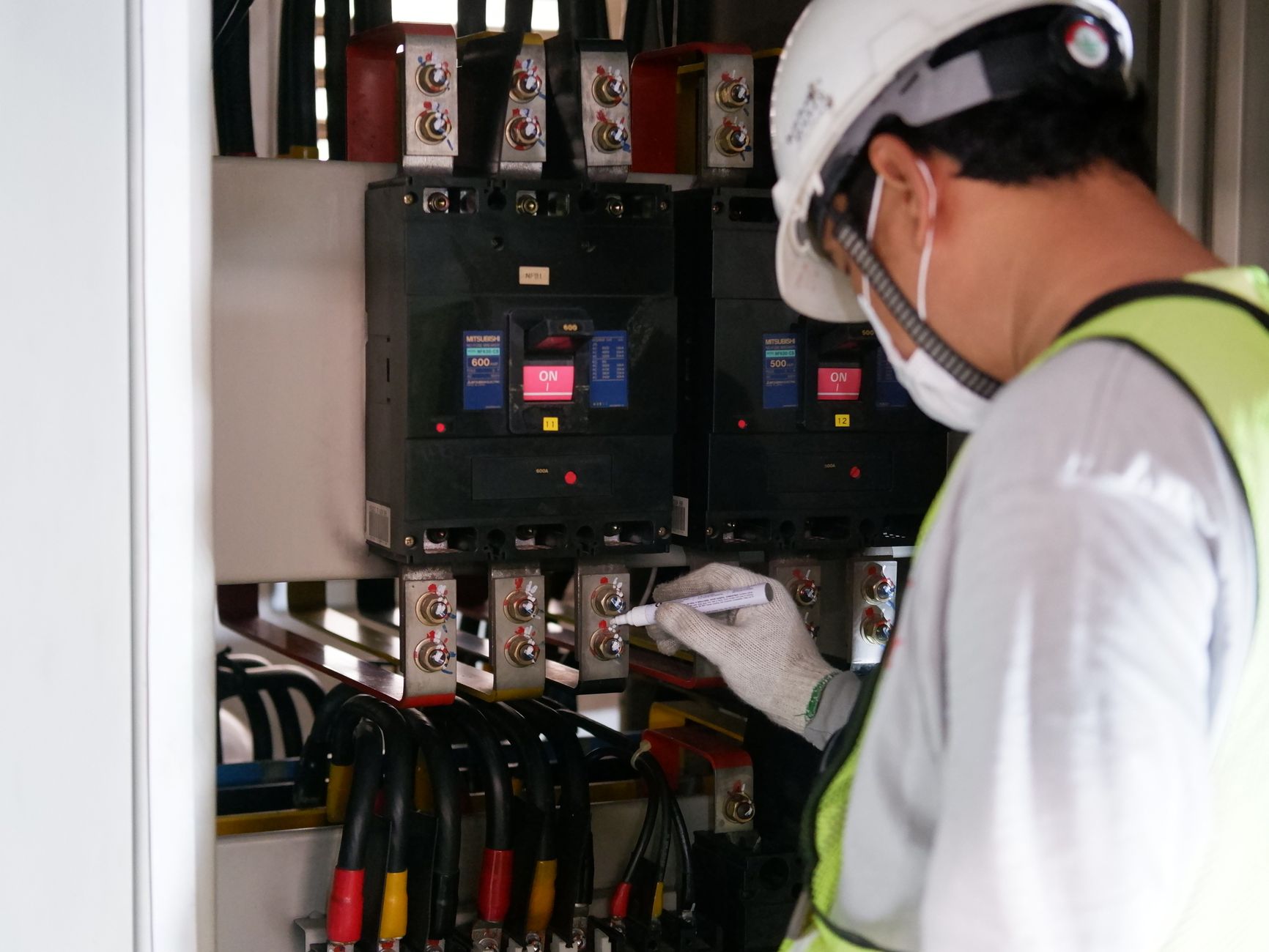
* Thermographic Inspection: In commercial setups, loose terminal screws cause high contact resistance, generating localized heat that trips thermal breakers. Electrical maintenance teams should conduct annual infrared thermal scanning to detect loose terminal points before they fail.
* Install Genuine Switchgear: Replace unbranded or dubious switchgear with certified components from manufacturers conforming to IEC 60898-1 or IEC 60947-2 standards.
* Engage Certified Contractors: Complex distribution failures, frequent earth leakage trips, and phase load balancing require licensed expertise. Engaging a PEC-registered firm like Abdullah International ensures that installations, cable sizing, and fault investigations strictly comply with national safety codes and industrial engineering standards.
Conclusion
A tripping circuit breaker is not an inconvenience to be bypassed by wedging the switch or installing an oversized breaker; it is a critical safety response to thermal overload, leakage, or short circuit conditions. Overlooking persistent trips risks cable degradation, damaged appliances, and electrical fires. For persistent electrical faults that go beyond simple appliance isolation, contact Abdullah International to carry out formal fault finding, thermal auditing, and preventative maintenance on your electrical distribution infrastructure.