Why Your Breakers Keep Tripping: Causes and Fixes in Pakistan | Abdullah International
Maintenance
Why Your Breakers Keep Tripping: Causes and Fixes in Pakistan
By Muhammad Adnan Chattha··
Frequent breaker tripping disrupts operations and risks electrical fires. Learn the key causes, systematic fault finding steps, and repair costs in PKR.
A tripping circuit breaker is an essential safety response, not an arbitrary inconvenience. When a miniature circuit breaker (MCB) or molded case circuit breaker (MCCB) cuts power to a circuit, it prevents conductor insulation from melting, protects connected machinery, and eliminates an immediate fire hazard. In Pakistan, where commercial facilities and residences face unstable grid supplies from distribution companies (DISCOs) like FESCO, LESCO, and K-Electric, tripping issues are exceptionally common. Diagnosing the root cause requires moving beyond simply pushing the switch back up. Resetting a breaker repeatedly without identifying the underlying defect degrades the breaker's internal bimetallic strip and magnetic coil, eventually causing catastrophic failure.
Understanding the Primary Causes of Breaker Tripping
A circuit breaker trips primarily under three electrical conditions: sustained overloads, short circuits, and ground faults. An overload occurs when the aggregate current draw of connected loads exceeds the breaker's rated ampere capacity (for instance, drawing 24A through a standard 16A C-curve MCB). In Pakistani commercial and residential properties, overloads frequently occur during summer months when 1.5-ton inverter air conditioners, refrigeration units, and water pumps operate simultaneously on single-phase distribution boards that were never sized for modern loads.
A short circuit is a direct, zero-resistance connection between the active (phase) conductor and the neutral conductor. This produces an instantaneous current surge that can exceed several thousand amperes, triggering the breaker’s magnetic trip mechanism in less than 30 milliseconds. Short circuits often stem from deteriorated PVC insulation inside conduits, pest damage, or loose wire strands making contact within switchboards.
Ground faults (or earth leakage) occur when an active conductor touches an earthed metal enclosure, conduit, or bare earth wire. If the distribution board incorporates a Residual Current Circuit Breaker (RCCB) or Earth Leakage Circuit Breaker (ELCB), it detects an imbalance between phase and neutral currents as low as 30mA to 100mA and trips instantly. In industrial installations around Faisalabad, unsealed terminal boxes exposed to humidity and fabric lint frequently develop low-resistance tracking paths to earth, causing erratic tripping.
The Impact of Local Climate and Grid Fluctuations
Environmental conditions in Pakistan directly affect circuit breaker performance. Thermal-magnetic MCBs rely on a calibrated bimetallic strip that bends as current heats it. Most international manufacturers (such as Schneider, ABB, or Terasaki) calibrate standard MCBs at an ambient temperature of 30°C. In Punjab and Sindh, ambient temperatures inside unconditioned electrical rooms and external distribution panels routinely hit 45°C to 50°C during peak summer. This extreme ambient heat pre-heats the internal bimetallic element, causing the breaker to trip at 70% to 80% of its rated current capacity—a phenomenon known as thermal derating.
Ready to Discuss Your Project?
Contact Abdullah International today for a professional consultation and quotation. Our team is ready to deliver reliable electrical infrastructure solutions for your project.
Grid voltage instability exacerbates this problem. When supply voltage from the local feeder drops from the nominal 230V down to 180V or lower—a frequent occurrence during peak hours—inductive loads such as induction motors, scroll compressors, and industrial sewing machines draw higher current to maintain their required mechanical output power ($P = V \times I \times \cos\phi$). This proportional rise in running current pushes circuits operating near their limits past the thermal trip threshold.
Furthermore, the widespread presence of counterfeit switchgear in local markets like Faisalabad’s Rail Bazaar or Lahore’s Shah Alam Market compounds the issue. Substandard breakers made with copper-clad aluminum contacts and substandard arc-chute assemblies either trip erratically at normal loads or fail to clear actual short circuits, posing severe safety hazards.
Systematic Fault Finding and Diagnostic Steps
Locating an electrical fault requires a structured process of elimination. Before opening any distribution board or testing live conductors, ensure the technician holds proper qualifications and uses an insulated multimeter rated for CAT III or CAT IV environments.
Begin by isolating all loads downstream of the tripping breaker. Turn off and unplug all appliances, machinery, and lighting fixtures supplied by that specific circuit. Attempt to reset the breaker to the "ON" position with zero load applied. If the breaker trips immediately upon being reset under zero-load conditions, the fault lies within the fixed wiring (such as a hard short circuit between line and neutral or line and earth) or the breaker mechanism itself has welded contacts.
If the breaker stays engaged with all loads disconnected, turn on each appliance or load one at a time. Monitor the circuit for several minutes after each unit is introduced. If a specific device causes the breaker to trip immediately upon activation, inspect that machine's motor windings, internal capacitor, or power supply cable. Variable frequency drives (VFDs) and switched-mode power supplies can also introduce high harmonic distortion and inrush currents that trip standard C-curve breakers, requiring an upgrade to D-curve breakers designed to handle high inrushes.
When the issue cannot be isolated by manual switching, conduct an insulation resistance test using an insulation tester (Megger). De-energize the main incoming supply completely. Apply a 500V DC test voltage between Phase and Neutral, Phase and Earth, and Neutral and Earth. According to PEC and IET wiring regulations, the insulation resistance must read well above 1 Megaohm ($\text{M}\Omega$). A reading below 0.5 $\text{M}\Omega$ indicates damaged cable insulation inside conduits, moisture ingress, or terminal degradation that requires physical tracing and conductor replacement.
Neutral-Earth Faults and Earthing Pit Failures
A frequently misunderstood cause of unexplained tripping—specifically on RCCB-protected circuits—is a neutral-to-earth fault. In many Pakistani properties, neutral lines from different sub-circuits are mistakenly interconnected inside junction boxes, or an appliance has developed a minor neutral-to-chassis leak. Even if the active pole of the sub-circuit is turned off, return current from an entirely different circuit can flow through the linked neutral line back to earth, unbalancing the current transformer in the RCCB and causing it to trip intermittently.
Earthing systems in Pakistan also suffer from poor maintenance. Standard pipe or chemical earth pits should maintain an earth resistance value below 5 ohms for commercial setups and below 1-2 ohms for industrial installations. During dry months, the soil resistivity around untreated charcoal-and-salt pits climbs drastically. A high-resistance earth path prevents short-circuit currents from reaching the magnitude necessary to trip a standard MCB quickly, leaving the system in a continuous fault state that slowly overheats the switchgear until it trips thermally or damages upstream equipment.
Testing earth loop impedance using an earth resistance tester is critical during routine maintenance to ensure fault currents have an unobstructed low-impedance path back to the source.
Remedial Solutions and Estimated Costs in PKR
Resolving recurring breaker tripping requires correct engineering practices rather than simply installing a larger breaker. Upsizing a 16A breaker to a 32A breaker on a 2.5 mm² cable eliminates the tripping temporarily, but it turns the internal building wiring into an unmonitored heating element, creating a severe fire hazard.
Depending on the diagnostic findings, typical repairs and component replacements in Pakistan involve the following market-aligned costs:
* High-Quality Single-Pole MCB Replacement (Schneider, Hager, ABB): Replacing defective or derated 10A–32A single-pole breakers with genuine, calibrated units costs approximately PKR 1,200 to PKR 2,800 per pole, excluding labor.
* Three-Phase MCCB Replacement (100A–250A): For commercial distribution boards, genuine adjustable MCCBs run between PKR 28,000 and PKR 75,000 depending on breaking capacity (kA rating).
* Residual Current Circuit Breaker (RCCB/ELCB, 2-pole or 4-pole, 30mA/100mA): Upgrading or replacing sensitive residual devices ranges from PKR 6,500 to PKR 18,000.
* Dedicated Sub-Circuit Rewiring: Running a new 4 mm² or 6 mm² single-core copper cable (such as Pakistan Cables or Fast Cables) through existing conduit to split an overloaded circuit costs roughly PKR 250 to PKR 450 per meter for materials, plus installation labor.
* Chemical Earth Pit Installation: Replacing dried-out, substandard charcoal pits with a maintenance-free chemical copper-bonded rod system costs between PKR 40,000 and PKR 85,000 per pit, yielding earth resistance values below 2 ohms.
Working with experienced professionals ensures safety. Abdullah International provides testing, load auditing, and panel rehabilitation across industrial and commercial facilities to resolve these systemic design issues permanently.
Preventive Maintenance Protocols for Distribution Boards
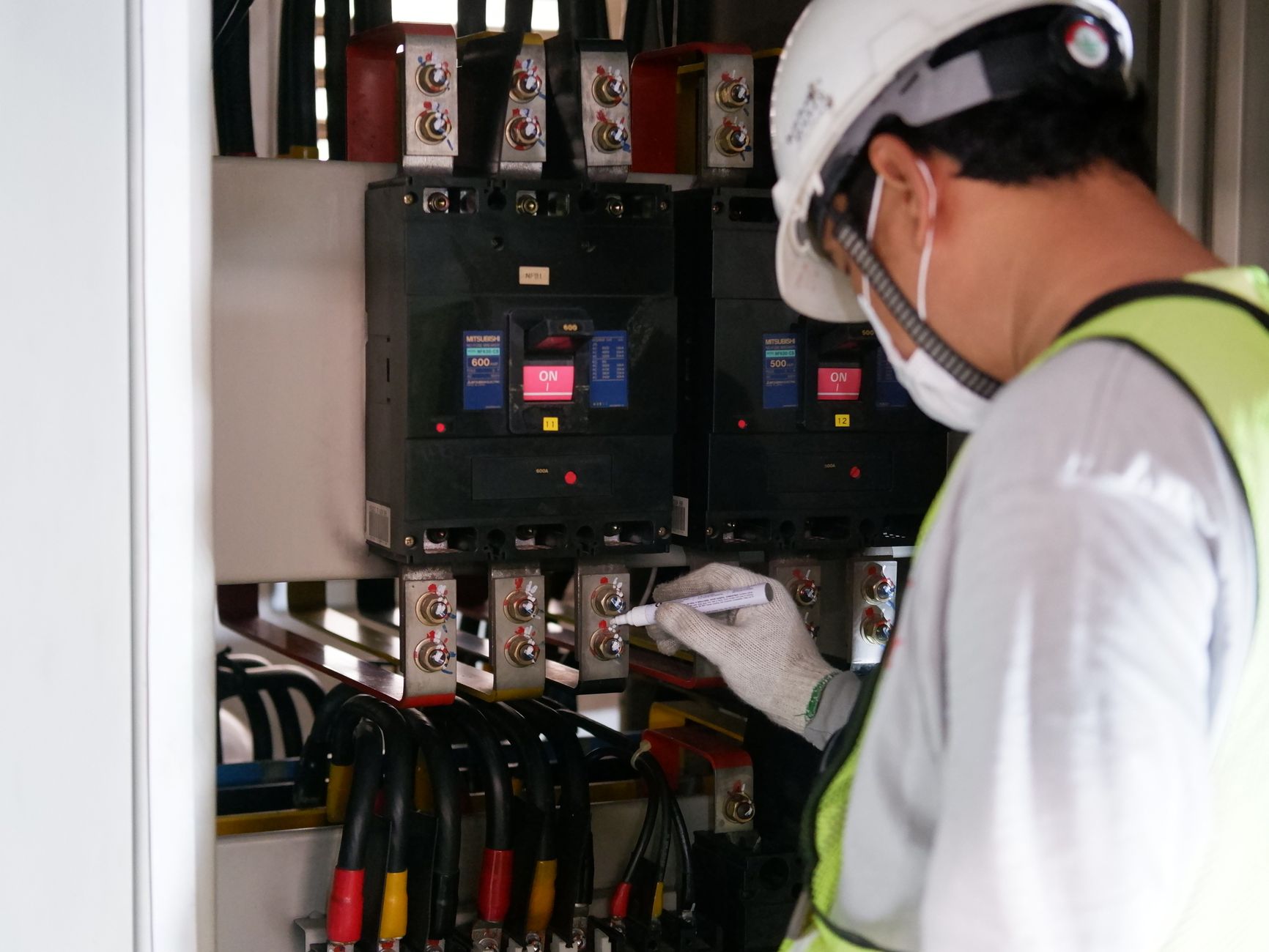
Preventing future tripping requires scheduled maintenance rather than reactive repairs. Every distribution board should undergo a visual and mechanical inspection twice a year. Loose screw terminals are one of the most common causes of high-resistance heating in distribution panels; when terminals run hot, heat travels down the terminal screw into the breaker body, inducing premature thermal tripping. All connections should be checked and tightened to the manufacturer's specified torque using insulated torque screwdrivers.
Infrared thermography is an invaluable, non-invasive maintenance practice. A thermographic camera scans the panel under full operating load, instantly revealing hot spots caused by phase imbalances, overloaded busbars, or internally degraded breaker contacts long before a trip occurs.
Finally, single-phase loads across three-phase distribution systems must be dynamically balanced. In mixed-use facilities, electricians often add new single-phase machines or server racks to the nearest available terminal, overloading Phase R while Phases Y and B remain underloaded. Measuring running currents with a true-RMS clamp meter and re-distributing loads across the three phases balances transformer loading, drops neutral currents to near zero, and stops single-phase breaker tripping across the facility. Abdullah International implements these predictive maintenance procedures to keep switchgear running smoothly under peak operating conditions.
Conclusion
A circuit breaker that trips repeatedly is a critical warning sign that your electrical system is operating outside its designed safety parameters. Whether the root cause is high summer ambient temperatures, persistent phase imbalances, degraded conductor insulation, or counterfeit switchboard components, the solution is never to install a larger-capacity breaker over an undersized wire. Perform a structured diagnostic isolation, verify insulation resistance with a calibrated tester, and calculate circuit loads against derated ambient conditions. Take action today: schedule an electrical load audit and insulation test on your main distribution boards to eliminate nuisance tripping, preserve your capital assets, and safeguard your facility against electrical fire hazards.