
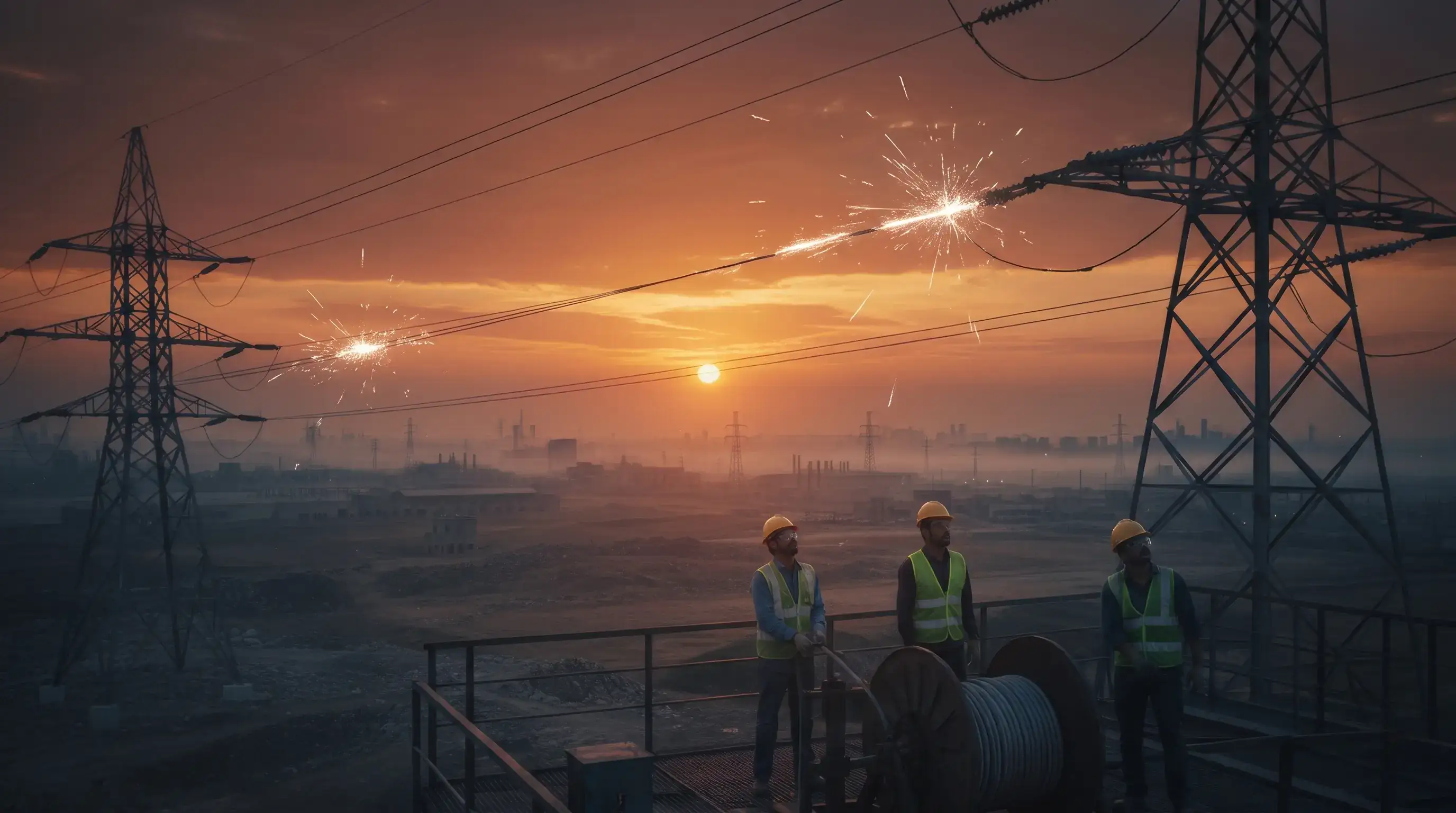
In an industrial facility or utility distribution network, a power transformer is often the single most expensive asset in the electrical yard. When a transformer fails catastrophically, the direct replacement cost can run into tens of millions of rupees, not to mention the financial bleed from unscheduled factory downtime. In Pakistan's harsh operating environments—where summer ambient temperatures regularly cross 45°C in industrial hubs like Faisalabad, Multan, and Gujranwala—transformers face immense thermal stress.
Regular preventive maintenance depends heavily on fluid condition monitoring. Transformer oil serves a dual purpose: it acts as an electrical insulator and a heat-transfer medium. Monitoring the physical and chemical condition of this fluid provides a clear window into the internal health of the core, windings, and solid insulation. Among all diagnostic procedures, Dissolved Gas Analysis (DGA) is universally recognized as the most effective early-warning tool for detecting developing faults before they trigger a protective trip or an explosion.
Why Transformer Oil Degrades in Pakistan's Climate
Transformer mineral oil is a refined hydrocarbon fluid consisting of naphthenes, paraffins, and aromatics. Under ideal conditions, this oil maintains high dielectric strength and chemical stability for decades. However, local operational realities accelerate the rate of degradation. Industrial areas in Punjab and Sindh suffer from severe dust loading, frequent seasonal humidity shifts, and unstable grid parameters characterized by voltage fluctuations and rapid load rejections from local distribution companies (DISCOs).
When a transformer operates at high continuous loads during peak summer months, winding temperatures spike. In the presence of atmospheric oxygen drawn through faulty silica gel breathers, the hydrocarbon molecules oxidize. This process generates peroxides, low-molecular-weight acids, and sludge. The resulting acidic compounds attack the cellulosic paper insulation wrapped around the copper conductors, lowering its mechanical tensile strength.
Simultaneously, moisture absorption reduces the oil's breakdown voltage. Moisture levels above 30 parts per million (ppm) in high-voltage equipment drastically increase the probability of an internal flashover. Sludge deposits settle on the radiator cooling tubes and winding ducts, impeding natural convection and raising internal core temperatures further. This continuous feedback loop of heat, moisture, and oxidation makes systematic oil testing mandatory rather than optional.
Key Diagnostic Parameters in Routine Oil Testing
Before examining dissolved gases, maintenance engineers review the standard physical and chemical properties of the dielectric fluid. These baseline parameters show whether the oil is still fit to insulate and cool the unit:
* Dielectric Breakdown Voltage (BDV): Measured in kilovolts (kV) across a standard gap using IEC 60156 standards. New processed oil should withstand 60 kV or more. In operating transformers rated 11kV to 132kV, oil with a BDV dropping below 30 kV requires immediate filtration or vacuum dehydration. * Moisture Content: Expressed in ppm (mg/kg) via Karl Fischer titration (ASTM D1533). For 132kV transformers, moisture should ideally remain below 15 ppm; for 11kV distribution units, under 25 ppm is acceptable. * Interfacial Tension (IFT): Measured in dynes per centimeter (mN/m). New oil typically exhibits an IFT between 40 and 50 mN/m. As polar contaminants and oxidation byproducts accumulate, this value drops. An IFT reading below 22 mN/m signals advanced oxidation and imminent sludge drop-out. * Total Acidity / Neutralization Number: Expressed as milligrams of potassium hydroxide needed to neutralize the acid in one gram of oil (mg KOH/g). Acid levels exceeding 0.15 mg KOH/g indicate that the oil is actively deteriorating the solid paper insulation.
While these standard checks confirm whether the oil needs dehydration or replacement, they cannot pinpoint active electrical discharges or localized overheating inside the tank. That critical job belongs to Dissolved Gas Analysis.
Understanding Dissolved Gas Analysis (DGA)
Dissolved Gas Analysis involves extracting the combustible and non-combustible gases dissolved in transformer oil and quantifying them via gas chromatography (IEC 60567 / ASTM D3612). Under electrical and thermal stresses, the liquid hydrocarbon molecules ($C_n H_{2n+2}$ or $C_n H_{2n}$) and solid cellulose polymers ($[C_6 H_{10} O_5]_n$) break down into microscopic gas molecules that dissolve directly into the surrounding fluid.
Different stress mechanisms sever distinct chemical bonds at specific energy levels:
* Hydrogen ($H_2$): Formed primarily by partial discharge (corona) phenomena or low-energy electrical activity that cleaves low-energy carbon-hydrogen bonds. * Methane ($CH_4$) and Ethane ($C_2H_6$): Generated by low-to-medium thermal faults where oil breaks down at temperatures between 150°C and 500°C. * Ethylene ($C_2H_4$): Associated with high-temperature thermal faults in the oil, typically exceeding 500°C, such as localized hotspots on core laminations or poor internal connections. * Acetylene ($C_2H_2$): Requires substantial energy to break and re-form into a triple carbon bond. It is the signature gas of high-energy electrical arcing, continuous sparking, or direct short circuits where local temperatures exceed 800°C to 1000°C. * Carbon Monoxide ($CO$) and Carbon Dioxide ($CO_2$): The primary decomposition byproducts of paper and pressboard insulation. A high concentration of these gases signals degradation of the transformer's solid mechanical structure.
Interpreting DGA Signatures: Fault Types and Ratios
Interpreting a DGA test report involves more than looking at absolute gas concentrations in parts per million. Plant engineers must evaluate gas ratios, generation rates over time, and the proportion of specific gases relative to Total Dissolved Combustible Gas (TDCG).
### 1. Partial Discharge (Corona) Low-energy electrical discharges occurring in gas-filled cavities within the solid insulation or gas bubbles in the oil produce high amounts of Hydrogen ($H_2$), with small quantities of Methane ($CH_4$). If $H_2$ values jump from a baseline of 20 ppm to several hundred ppm without a concurrent rise in hydrocarbons, localized corona discharge is occurring.
### 2. Thermal Faults (Hotspots) Thermal faults occur when loose busbar connections, bad tap-changer contacts, circulating currents in the tank walls, or blocked cooling passages create isolated zones of intense heat. * Low to Medium Temperature (< 300°C to 500°C): Methane ($CH_4$) and Ethane ($C_2H_6$) are dominant. * High Temperature (> 500°C to 700°C+): Ethylene ($C_2H_4$) rapidly increases and outpaces Methane. An Ethylene-to-Ethane ratio significantly greater than 1.0 indicates severe localized overheating, such as a loose bolted connection on an internal bushing lead.
### 3. Electrical Arcing When a phase-to-phase flashover, winding puncture, or heavy discharge occurs, Acetylene ($C_2H_2$) appears instantly. Any confirmed presence of Acetylene above 2 to 5 ppm requires prompt investigation. If Acetylene levels climb beyond 20 to 30 ppm, the transformer must be de-energized immediately to prevent internal tank rupture.
### 4. Cellulose Degradation The ratio of Carbon Dioxide to Carbon Monoxide ($CO_2 / CO$) reveals whether the solid paper insulation is cooking. Under normal aging conditions, the $CO_2 / CO$ ratio generally sits between 5 and 10. A ratio dropping below 3 indicates rapid paper overheating, which permanently destroys the mechanical integrity of the winding wraps. Conversely, very high ratios (above 20) indicate low-temperature paper degradation caused by moisture and oxidation.
### 5. Ratio Methods (Duval Triangle & Rogers Ratios) Diagnostic systems such as the Duval Triangle (IEC 60599 Annex B) plot percentages of three key gases ($CH_4$, $C_2H_4$, and $C_2H_2$) on triangular coordinates. This graphical tool separates faults into specific zones: PD (Partial Discharge), T1 (Thermal fault < 300°C), T2 (Thermal fault 300°C–700°C), T3 (Thermal fault > 700°C), D1 (Low energy discharge), and D2 (High energy discharge). Engineering teams rely on these coordinates to diagnose issues without relying on subjective guesswork.
| Fault Designation | Primary Gas Indicator | Secondary Gas Indicator | Typical Underlying Issue | | :--- | :--- | :--- | :--- | | Partial Discharge (PD) | Hydrogen ($H_2$) | Trace Methane ($CH_4$) | Voids in insulation, moisture pockets | | Thermal Fault < 300°C (T1) | Ethane ($C_2H_6$) | Methane ($CH_4$) | Overloaded windings, inadequate cooling | | Thermal Fault 300°C–700°C (T2)| Ethylene ($C_2H_4$) | Ethane ($C_2H_6$) | Bad tap changer contacts, eddy currents | | Thermal Fault > 700°C (T3) | Ethylene ($C_2H_4$) | Methane ($CH_4$) | Core lamination short, joint welding | | Low Energy Arc (D1) | Acetylene ($C_2H_2$) | Hydrogen ($H_2$) | Tracking in solid insulation, static spark | | High Energy Arc (D2) | Acetylene ($C_2H_2$) | Hydrogen / Ethylene | Phase-to-ground flashover, coil puncture |
Recommended Action Limits and Standards
Standards such as IEC 60599 and IEEE C57.104 set baseline boundaries for interpreting dissolved gas concentrations. Because background levels vary based on transformer age, manufacturer, and loading history, engineers track both absolute values and the rate of rise over time:
1. Condition 1 (Normal): TDCG below 720 ppm with low individual gas levels ($H_2 < 100$, $CH_4 < 120$, $C_2H_2 < 1$, $C_2H_4 < 50$ ppm). Continue routine annual sampling. 2. Condition 2 (Elevated): TDCG between 721 and 1920 ppm, or any gas increasing at more than 10% per month. Increase sampling frequency to quarterly. Check load cycles and verify cooling fan operation. 3. Condition 3 (High Risk): TDCG between 1921 and 4630 ppm. Take monthly samples, prepare contingency spare parts, and reduce transformer loading where possible. 4. Condition 4 (Extreme Danger): TDCG exceeds 4630 ppm, or Acetylene exceeds 35 ppm with an active upward trajectory. Plan an immediate controlled shutdown for internal inspection and offline diagnostics.
Testing Costs, Sampling Best Practices, and Maintenance in Pakistan
DGA accuracy depends on proper oil sampling procedures. Drawing an oil sample into an open plastic bottle ruins the test; ambient air and moisture will quickly contaminate the sample, artificially driving up dissolved oxygen, nitrogen, and moisture readings while allowing dissolved gases like hydrogen to escape.
Technicians must use gas-tight, ground-glass syringes (usually 50 ml) fitted with three-way stopcocks, or certified stainless steel sample cylinders. The sampling valve at the bottom of the transformer tank should be thoroughly purged—draining at least 2 to 5 liters of waste oil into a bucket to clear accumulated debris—before the syringe is filled without turbulence or air bubbles.
In Pakistan, basic physical and chemical tests (BDV, moisture, acidity) cost between PKR 10,000 and PKR 18,000 per sample. Full gas chromatography DGA testing typically ranges from PKR 25,000 to PKR 45,000 per transformer test, depending on the analytical laboratory. Leading testing facilities include high-voltage laboratories at research institutes in Lahore and Islamabad, as well as specialized third-party engineering services.
Industrial operations that neglect this testing risk massive capital losses. A 2.5 MVA 11/0.415 kV industrial transformer costs upwards of PKR 6.5 to 8.5 million, while a 20/26 MVA 132/11 kV power transformer can exceed PKR 90 to 120 million. Spending a small fraction of that sum on semi-annual oil analysis is cheap insurance. Contractors like Abdullah International emphasize oil quality management when commissioning, maintaining, and rehabilitating industrial grid stations across the country. Addressing gas trends early through high-vacuum oil dehydration, on-site degasification, or regasketing prevents catastrophic failures and significantly extends substation operating life.
Conclusion
Dissolved Gas Analysis transforms transformer maintenance from an emergency response into a planned, data-driven operation. By measuring parts-per-million levels of Hydrogen, Ethylene, and Acetylene, maintenance personnel can catch loose connections, mechanical rubbing, or insulation tracking months before an unexpected trip interrupts operations.
Review the most recent test logs for all high-voltage transformers in your substation today. If an asset has not undergone a laboratory DGA in the last 12 months—or if your current report shows Acetylene levels trending above 2 ppm or Ethylene above 50 ppm—schedule a syringe sample extraction immediately to confirm your equipment remains safe to run.